
Source: Google Threat Intelligence Group (GTIG), “Adversaries Leverage AI for Vulnerability Exploitation, Augmented Operations, and Initial Access” — May 11, 2026. This memo summarizes key findings and their implications for your organization’s risk profile.
The Big Picture: What Google’s Intelligence Team Found
Google’s threat intelligence team published a landmark report documenting a fundamental shift in how cyberattacks are being carried out: artificial intelligence has become a standard weapon in attackers’ arsenals. The following is what the report found actively occurring:
-
-
• AI is discovering security flaws automatically: For the first time, Google confirmed that a zero-day exploit (a previously unknown vulnerability) was developed using AI. Attackers used it to plan a mass exploitation campaign targeting thousands of organizations simultaneously.
• Malware is now designed to fool your defenses: Russia-linked and other state-sponsored hackers are using AI to write malware that camouflages itself with decoy code, making it harder for traditional security tools to detect. One malware family included 32 repetitive, benign-looking code queries just to appear harmless.
• Attacks are becoming autonomous: A new Android malware called PROMPTSPY operates without human supervision: it navigates your phone’s interface, blocks uninstallation by placing an invisible overlay over the uninstall button, and can be updated remotely even if its infrastructure is identified and blocked.
• Phishing has become surgical: Attackers are using AI to research company org charts, vendor relationships, and individual employee roles before crafting personalized emails. The days of easily spotted mass-spam phishing are giving way to targeted messages that reference real people, real vendors, and real projects.
• Your AI tools are now a target: A criminal group compromised widely-used AI software packages including a popular AI gateway tool, stealing cloud credentials that were then sold to ransomware groups. If your organization uses AI software, those integrations expand your attack surface.
-
Why This Matters for Your Business
-
• The barrier to entry for sophisticated attacks has collapsed: AI has made expert-level hacking accessible to a far broader pool of adversaries. You do not need to be a Fortune 500 company to be in the crosshairs.
• Time-to-impact is compressing: AI automates the steps between initial compromise and ransomware deployment. Incident response windows that used to be measured in days are shrinking.
• No organization is too small to be a supply chain target: Attackers do not always come at you directly. They compromise a software tool you and thousands of others use, gaining access to all of you at once.
• Deepfake impersonation is operational, not hypothetical: AI voice cloning is actively being used to impersonate journalists, executives, and public figures. Business email compromise and wire fraud schemes now have an audio and video dimension.
• Your risk profile has changed even if your operations haven’t: AI has materially increased the frequency and sophistication of attacks against organizations of every size. Coverage and controls that were adequate two years ago may not reflect today’s environment.
-
-
How Insurance Responds: Key Coverage Areas to Review:
-
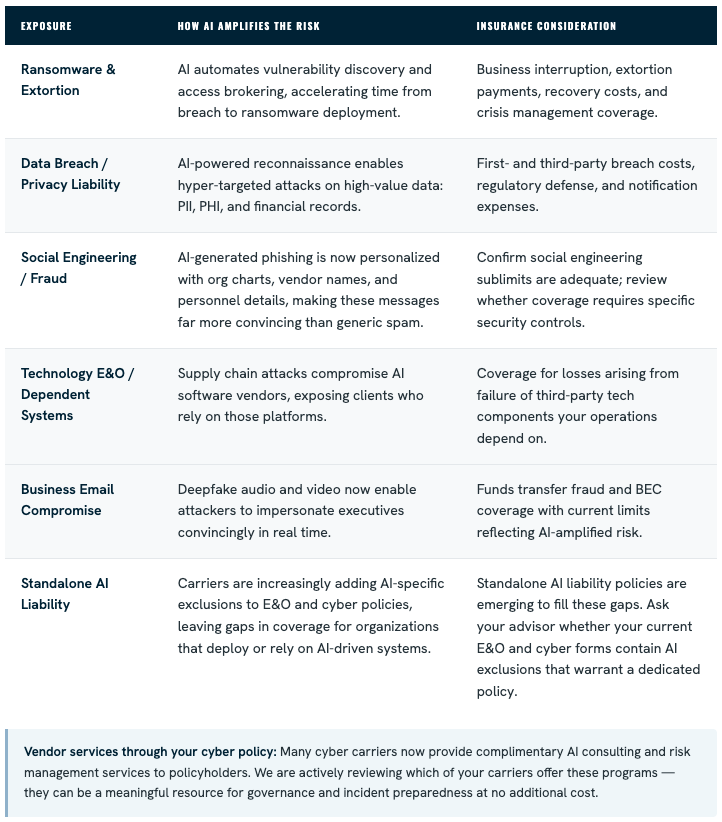
The Regulatory Landscape: What’s Coming and When
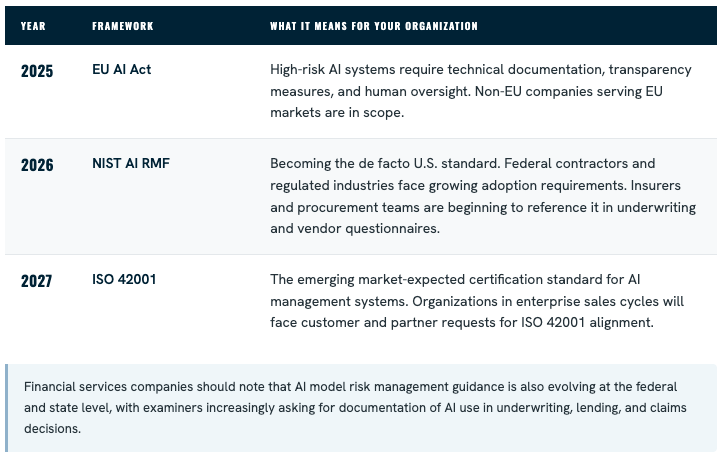
AI governance is shifting from best practice to legal obligation. The regulatory timeline is compressed, and organizations that wait for binding enforcement to arrive will face a harder and more expensive path to compliance. Cyber insurance carriers and enterprise procurement teams are increasingly referencing these frameworks in applications and vendor reviews.
-
-
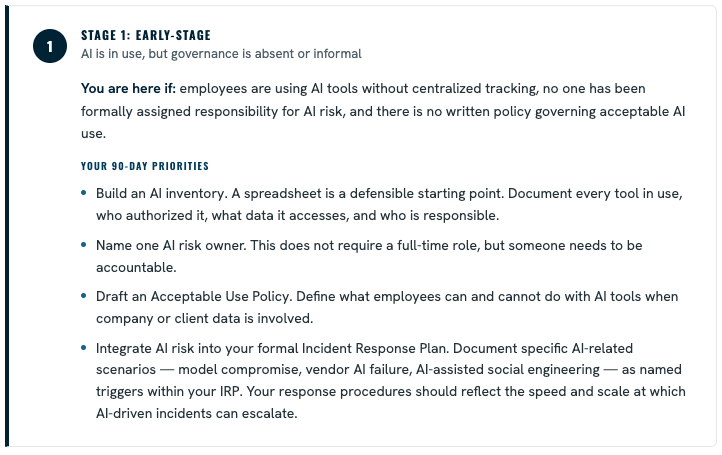
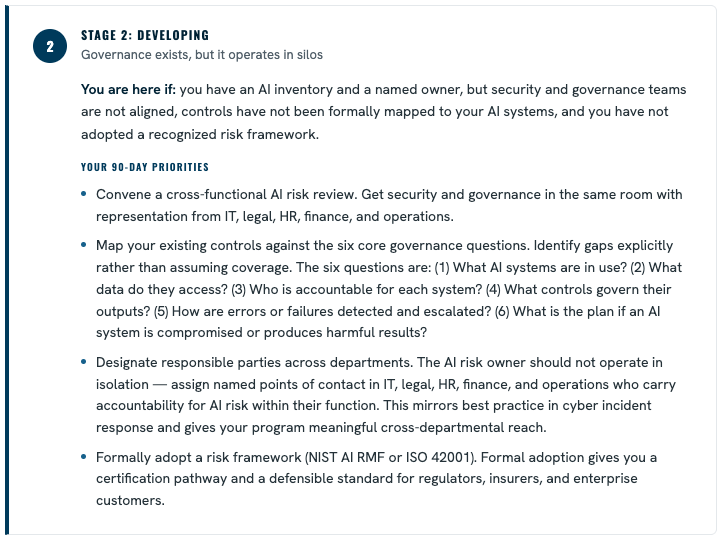
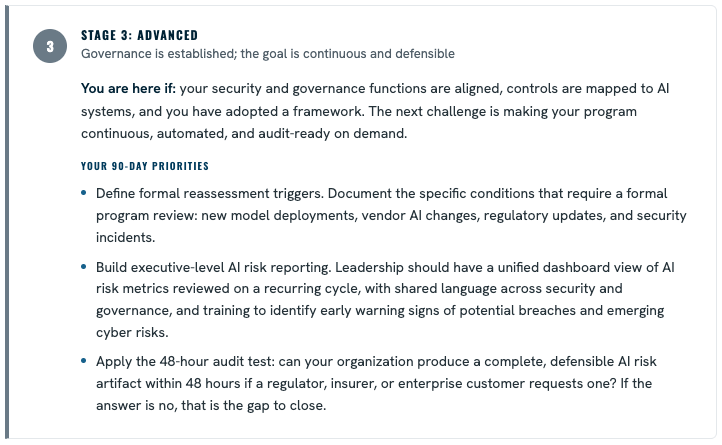
Where Does Your Organization Stand? A 90-Day Roadmap by Maturity
-
-
Not every organization is starting from the same place on AI governance. Identify your current stage below, then focus your next 90 days on the actions listed for that tier.
What We Recommend Discussing with Your Advisor
-
• Audit your AI software footprint: Identify every AI tool, plugin, or third-party integration in use across your organization. Each one is a potential supply chain entry point.
-
• Review ransomware sublimits: Many policies introduced ransomware sublimits in recent years. Confirm those limits still reflect your actual exposure given AI-accelerated attack timelines.
-
• Evaluate social engineering coverage: Verify your policy covers AI-generated phishing and impersonation scenarios, and confirm that coverage does not depend on security controls you may not currently have in place.
-
• Confirm your incident response plan is current: Autonomous malware and faster attack timelines demand a response plan that has been tested within the past year. One written before AI-powered threats became standard is no longer adequate.
-
• Discuss re-underwriting if your AI usage has grown: If your organization has adopted new AI tools since your last renewal, disclose that proactively. It positions you as a more credible risk and prevents coverage disputes after a claim.
Additional Resources
The following resources are recommended by practitioners and referenced by regulators and insurers:
• NIST AI Risk Management Framework (AI RMF) — The primary U.S. federal standard for AI risk governance. Free, framework-based, and increasingly referenced in procurement and insurance. airc.nist.gov• NIST AI RMF Playbook — Practical implementation guidance with mapped actions for each function of the RMF. airc.nist.gov/Docs/2• ISO 42001 Overview — The international certification standard for AI management systems. Relevant for organizations with enterprise customers or international operations. iso.org• EU AI Act Summary — Plain-language summary of the EU regulatory framework. Relevant for any organization that operates in or sells into European markets. artificialintelligenceact.eu• CISA AI Security Guidance — Cybersecurity and Infrastructure Security Agency guidance on AI security. Practical and security-focused. cisa.gov/ai• Cranium AI Governance Platform — A purpose-built tool for AI inventory management and continuous AI risk monitoring. cranium.ai
-
-
-